I Read About Da Vinci’s Vitruvian Man , Here’s What I Found Interesting
Tejas GK| (1mo ago)
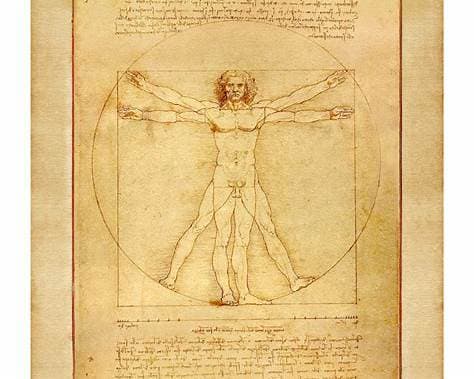
I was reading about Leonardo da Vinci’s Vitruvian Man, and I always thought it was just one of those famous Renaissance drawings everyone recognizes but nobody really thinks about.
You know the one.
A naked guy.
Multiple arms.
Multiple legs.
Inside a circle and a square.
I never really knew what it was supposed to mean.
Turns out, it is basically Leonardo trying to understand whether the human body can be described mathematically.
And that immediately made it way more interesting to me.
It Wasn't Just an Art Piece
The Vitruvian Man was based on ideas from an ancient Roman architect called Vitruvius.
Vitruvius wrote about ideal proportions in the human body and how those proportions could relate to architecture.
Leonardo took that idea and actually tried to visualize it.
So the drawing is not just:
"Here is a well-drawn human."
It is more like:
"What if the human body follows a geometric system?"
That is such a Da Vinci question.
He was not separating art, science, anatomy and engineering the way we often do today.
To him, they were all connected.
The Circle and the Square Matter
The first thing I wondered was why the man is standing inside both a circle and a square.
It is not random.
The square and circle were considered very important geometric forms, and Leonardo was trying to fit the human body inside both.
When the arms and legs are positioned one way, the body fits inside the square.
Change the position, and it fits inside the circle.
That is why there are multiple arms and legs in the drawing.
He is basically showing multiple positions at the same time.
It almost looks like animation frames drawn on top of each other.
The Human Body as Geometry
One of the main ideas is that different parts of the body have predictable proportions.
For example, one of the most famous observations is:
Your arm span is approximately equal to your height.
So if someone is 170 cm tall, their fingertip-to-fingertip arm span is often somewhere around 170 cm too.
There were several other proportions Vitruvius described.
Things like the size of the head, face, foot and hand compared to the total body.
Leonardo was essentially measuring the body and asking:
Is there a mathematical relationship between all these parts?
Today this sounds normal because we have anatomy textbooks and massive amounts of biological data.
But Leonardo was doing this more than 500 years ago.
Leonardo Was Obsessed With Anatomy
This also makes much more sense when you realize how obsessed Leonardo was with understanding the human body.
He dissected human bodies.
He drew muscles.
Bones.
Organs.
The heart.
The skull.
The spine.
Pregnancy.
Basically anything he could examine.
His anatomical drawings sometimes look like something you would expect from a modern medical textbook.
So when he drew the Vitruvian Man, he was not just imagining what an ideal body should look like.
He was actively studying how bodies were constructed.
That is probably why the drawing feels different from a normal artistic nude.
It feels almost technical.
Renaissance People Had This Idea of the Human as a Microcosm
Another thing I found interesting is the philosophical side.
There was this Renaissance idea that the human body was a kind of microcosm.
Basically:
The small structure of the human body reflects the larger structure of the universe.
Humans were seen as sitting somewhere between nature, mathematics and the cosmos.
Which sounds slightly mystical today, but I actually like the underlying thought.
They were trying to find patterns connecting different areas of reality.
Geometry appears in architecture.
Geometry appears in nature.
Maybe geometry appears in the human body too.
Instead of treating all these subjects as isolated fields, they were asking whether the same underlying principles might connect everything.
Da Vinci Didn't Think Like "An Artist"
This is probably the part that interests me most about Leonardo.
Today we label people very aggressively.
Programmer.
Designer.
Doctor.
Engineer.
Artist.
Scientist.
You pick your thing.
Leonardo apparently did not care.
He painted the Mona Lisa.
Designed machines.
Studied water.
Studied flight.
Studied anatomy.
Studied optics.
Made maps.
Designed weapons.
Investigated geometry.
He was basically permanently curious.
And the Vitruvian Man is a perfect example of that.
If an artist looked at the human body, maybe they would ask:
How do I draw this beautifully?
If an anatomist looked at it:
How are the muscles arranged?
If a mathematician looked at it:
What are the proportions?
If an architect looked at it:
How could these proportions influence buildings?
Leonardo somehow asked all of them.
The Arm Span Thing Made Me Test It
Obviously, once I read that arm span is supposed to roughly equal height, I immediately wanted to measure it.
Because that is the nice thing about something like the Vitruvian Man.
You can actually test some of these claims yourself.
Stand against a wall.
Stretch both arms completely sideways.
Measure fingertip to fingertip.
Then compare it to your height.
It probably will not be perfectly identical.
Humans are not manufactured from one CAD model.
But it is surprisingly close for many people.
And suddenly a 500-year-old drawing turns into something you can physically test in your bedroom.
That is cool.
It Isn't Saying Every Human Has Perfect Ratios
This part is important.
The Vitruvian Man is not proof that every single person has exactly the same body proportions.
We obviously do not.
People have:
Longer legs.
Shorter torsos.
Longer arms.
Different head sizes.
Different bone structures.
Leonardo was studying an ideal proportional model.
So I would not look at the drawing and think:
"My arms are 2 cm shorter than my height. Leonardo says I'm defective."
That is not the point.
It is an exploration of patterns.
It Reminds Me of Software Models
This is probably the nerdy connection my brain made.
When we design software systems, we constantly create simplified models of reality.
Imagine an e-commerce system.
A real customer is an absurdly complicated human being.
But inside the database:
User
- id
- name
- email
- address
We intentionally simplify reality into something understandable.
The Vitruvian Man feels slightly similar.
Leonardo takes this insanely complicated biological machine called a human being and asks:
Can I represent its structure using a few mathematical relationships?
Obviously, reality is more complicated than the model.
But the model helps us understand reality.
That is basically what good abstractions do.
The Original Isn't Always on Display
Something else I did not know: the original Vitruvian Man is held by the Gallerie dell'Accademia in Venice.
And apparently it is not permanently displayed.
That is because drawings on paper are extremely sensitive to light.
So one of the most famous images in human history spends much of its time protected from the thing required for humans to look at it.
There is something slightly funny about that.
We Mostly Know Leonardo Through Finished Images
Another thought I had while reading about this:
We remember Leonardo through masterpieces.
Mona Lisa.
The Last Supper.
Vitruvian Man.
But those are the outputs.
What is probably more interesting is the process behind them.
He filled notebooks with questions.
Sketches.
Half-finished ideas.
Mechanical designs.
Observations.
Measurements.
Things that were wrong.
Things that went nowhere.
Basically an enormous historical brain dump.
The Vitruvian Man itself almost feels like one page from that process that accidentally became globally famous.
And I actually find that more inspiring than the idea of Leonardo being some magical genius who simply knew everything.
He kept looking at things and asking questions.
"Can Humans Be Described Mathematically?"
If you reduce the Vitruvian Man to one question, I think it is this:
Can the structure of a human being be described using mathematics?
Today the answer is obviously:
Kind of.
We can measure bodies extremely precisely.
Model skeletons.
Simulate muscles.
Sequence genomes.
Analyze movement.
Build prosthetics using biomechanics.
Create digital humans.
But the human body is far too complex to reduce to a handful of ratios.
Leonardo obviously did not have CT scans, computers, machine learning or modern biology.
He had observation.
Measurements.
Geometry.
Paper.
And ridiculous curiosity.
Yet he was asking essentially the same type of question scientists and engineers still ask today:
Can we turn something complicated into a model we can understand?
Why I Like the Vitruvian Man Now
Before reading about it, I saw the Vitruvian Man as basically a famous old drawing.
Now I see it differently.
It is a diagram.
An experiment.
A piece of art.
An anatomy study.
A geometry exercise.
And a philosophical idea.
All sitting on the same sheet of paper.
And I think that is what makes Leonardo so fascinating.
He did not look at the world and see separate subjects.
He saw one giant system worth investigating.
The human body was not just something to paint.
It was something to measure.
Understand.
Dissect.
Compare.
Model.
Draw.
And question.
Maybe that is the most interesting lesson from the Vitruvian Man.
Not that your arm span is roughly equal to your height.
But that something you have looked at your entire life — even your own body — can become interesting again if you ask a better question.