Future is Facinating
Tejas GK| (3mo ago)
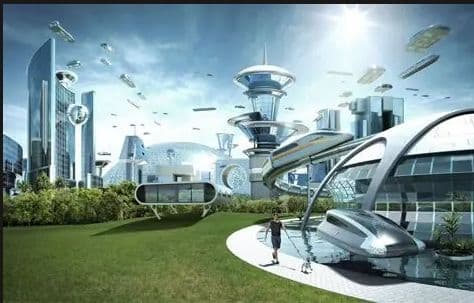
I've always wondered what the future will actually look like.
Imagine asking someone in the 1990s to describe the world of 2026. Their answer would inevitably be based on the technologies and problems they understood at the time. Some would predict flying cars. Others might imagine talking cars, humanoid robots walking everywhere, or cities that looked like something out of Blade Runner.
Some predictions would be surprisingly accurate. Others would be completely wrong.
That's the interesting thing about predicting the future: we imagine tomorrow using the rules of today.
So I'm probably going to be wrong about a lot of this too.
But looking at where biotechnology, artificial intelligence, energy, spaceflight and materials science are heading, there are a few things I think could fundamentally change civilization.
And I'm not talking about 2030 or 2040. I'm thinking much further ahead.
1. Synthetic Oil
Today, petroleum feels almost inseparable from modern civilization.
We burn it as fuel, but that's only part of the story. Petroleum is also used to manufacture plastics, chemicals, synthetic materials, lubricants, pharmaceuticals and countless everyday products.
The problem is that we're extracting carbon that was stored underground over geological timescales and consuming it extraordinarily quickly.
But what if we didn't have to extract it?
I think we'll eventually become extremely good at manufacturing hydrocarbons.
Instead of drilling into the Earth, we could take relatively simple inputs such as carbon dioxide, water and energy and rearrange their molecules into the hydrocarbons we need.
In other words, oil becomes something we manufacture rather than discover.
The interesting consequence isn't necessarily that fossil fuels survive forever. Electricity will probably replace petroleum in many applications simply because it's more efficient.
But wherever hydrocarbons remain useful, we may no longer depend on ancient deposits beneath the ground.
An oil field would essentially become a factory.
2. Eventually, Almost Any Material Could Be Manufactured
Synthetic oil is really part of a much bigger idea.
Everything around us is made from a relatively small collection of elements.
Carbon. Hydrogen. Oxygen. Silicon. Iron. Aluminium. Calcium.
The difference between completely different materials often comes down to how atoms are arranged and bonded together.
Carbon is the classic example.
Arrange carbon atoms one way and you get graphite.
Arrange them another way and you get diamond.
The atoms didn't change.
The structure did.
Human civilization has already learned how to manipulate matter in remarkable ways. We manufacture synthetic diamonds. We engineer polymers. We grow crystals. We create materials that would rarely, if ever, occur naturally.
I think this will continue until manufacturing becomes increasingly atomic and molecular.
Instead of asking:
"Where can we find this material?"
we may increasingly ask:
"What atoms do we need, and how do we arrange them?"
There are physical limits, of course. We aren't going to cheaply turn arbitrary matter into unlimited quantities of any element; nuclear transmutation has very different energy requirements from chemistry.
But for compounds and materials, the implications could still be enormous.
Scarcity wouldn't disappear, because energy, equipment, rare feedstocks and time would still matter.
But many forms of scarcity that seem fundamental today might eventually become manufacturing problems.
3. We Will Colonise Mars — and Eventually Venus
I don't think Earth will remain humanity's only home forever.
Mars is the obvious candidate.
It has water ice, a roughly 24.6-hour day and enormous quantities of raw material. It is incredibly hostile compared with Earth, but it's at least a world where humans could imagine building permanent enclosed settlements.
The first Martian cities probably won't look like science-fiction cities with people casually walking outside.
They may be underground or heavily shielded settlements protecting people from radiation and the extremely thin atmosphere.
But once a permanent population exists, something important changes.
Human civilization becomes multi-planetary.
Venus is much stranger.
Its surface is an absolute nightmare: crushing atmospheric pressure, extreme temperatures and an atmosphere dominated by carbon dioxide.
But around 50 kilometres above the surface, conditions become dramatically more interesting. Atmospheric pressure and temperatures can enter ranges much closer to those humans experience on Earth.
So perhaps the first Venusian settlements won't be on Venus.
They'll be floating above it.
Imagine enormous habitats suspended in the Venusian atmosphere: effectively cities in the clouds.
Mars gives us another surface.
Venus might give us another sky.
4. Custom Bodies
This is the prediction that I think could change the meaning of being human itself.
For almost all of history, your body has essentially been something you receive through genetic lottery.
Your height.
Your facial structure.
Your metabolism.
Your hair.
Your muscle-building potential.
Your susceptibility to certain diseases.
You can modify some of these things today, but only within fairly narrow biological limits.
I don't think that will always be true.
As we understand genetics, regenerative medicine, stem cells, tissue engineering and the mechanisms controlling development, humans may gradually gain much more control over their own biology.
Initially, the goal will probably be medical.
Grow replacement organs.
Repair damaged nerves.
Restore eyesight.
Regenerate cartilage.
Replace damaged skin.
Treat genetic diseases.
Then the boundary between medicine and enhancement will become increasingly blurry.
If we can regenerate damaged bone, can we reshape healthy bone?
If we can grow replacement hair follicles, can we choose exactly where and how they grow?
If we can engineer muscle tissue for someone suffering from muscular degeneration, can the same technology eventually enhance healthy muscle?
Far enough into the future, your biological body might become increasingly customizable.
Perhaps people will be able to change their appearance dramatically without today's invasive surgeries.
Maybe ageing itself will become something medicine can significantly slow, repair or partially reverse.
At that point, the body stops being something completely fixed at birth.
It becomes something we can increasingly edit.
5. Trees and Plants Will Grow the Way We Want Them To
Today, when we want a wooden table, we grow a tree, cut it down, transport the timber, cut the timber into pieces and then manufacture those pieces into a table.
That's an incredibly indirect process.
What if we could control how the tree grows in the first place?
Imagine guiding a tree so its branches naturally form structural components.
Imagine growing walls.
Furniture.
Bridges.
Shade structures.
Or entire buildings whose structural framework is alive.
This doesn't necessarily require some magical ability to command plants.
It could emerge from a combination of selective breeding, genetic engineering, synthetic biology, hormones, environmental control, robotics and computational models that understand plant growth.
We already shape plants through pruning and training.
The difference is precision.
Future agriculture might treat a plant almost like programmable biological machinery.
Instead of simply asking:
"How quickly can this tree grow?"
we might ask:
"What should this tree become?"
Cities themselves could eventually contain infrastructure that grows, repairs itself and absorbs carbon while doing so.
Instead of manufacturing everything in factories, some things may simply be grown.
6. Humanity Will Probably Become Less Religious — and More Broad-Minded
Technology won't be the only thing that changes.
Human culture will change with it.
For most of history, people lived inside relatively isolated cultural environments.
You were usually surrounded by people who spoke like you, believed similar things, followed similar traditions and had relatively limited exposure to completely different ways of living.
The internet shattered much of that isolation.
A teenager in India can talk to someone in Japan, watch an American scientist explain physics, listen to Korean music, learn philosophy from ancient Greece and debate someone in Brazil — all within the same afternoon.
I think that kind of interconnectedness will continue changing how humans see identity, culture and religion.
I don't think religion will necessarily disappear.
Humans seem deeply interested in meaning, ritual, community and questions that science doesn't necessarily answer for us.
But I suspect organized religion may become less dominant in many societies, while individual beliefs become more fluid.
People may increasingly identify less with:
"This is what my group believes."
and more with:
"This is what I personally believe after encountering many different ideas."
The bigger change might therefore not simply be less religion.
It could be less tribalism.
Nationality, ethnicity, religion and even geography may become weaker boundaries as humanity becomes increasingly connected — especially if we eventually become a civilization spread across multiple worlds.
The Bigger Pattern
There is a common thread running through almost all of these predictions.
Humanity is gradually turning things that were once determined by nature into things determined by choice.
We once had to find oil.
Eventually, we may manufacture it.
We once had to find materials.
Increasingly, we design them.
We were confined to one planet.
We are beginning to leave it.
We inherit our bodies.
We may eventually modify them.
Plants grow according to their own biological instructions.
We may learn to rewrite those instructions.
And we're born into cultures and belief systems largely determined by geography.
The internet is already weakening that constraint.
Maybe that is what the distant future actually looks like.
Not flying cars.
Not chrome skyscrapers.
Not humanoid robots walking down every street.
But something much more fundamental:
a civilization gaining increasing control over matter, biology, environment and ultimately its own future.
Of course, someone reading this decades or centuries from now might find these predictions hilarious.
Maybe I'll be as wrong as the people who thought we'd all have flying cars by 2020.
But that's part of the fun.
Every generation imagines the future using the limits of its own time.
And then the future arrives and breaks those limits anyway.